Four Features for Optimal QoE: The Bandwidth Management Stack an ISP Actually Needs
Why TCPO, AQM, ACM and DPI are each necessary — and why only their combination represents the state of the art.
Abstract. Subscriber Quality of Experience (QoE) is not produced by a single mechanism. It depends on how fast traffic can flow, on how a shared limit is divided, on whether the real bottleneck has been found, and on which applications deserve protection when capacity is scarce. Those are four distinct problems, and BQN addresses them with four functions: TCP Optimization (TCPO), Active Queue Management (AQM), Automatic Congestion Management (ACM), and Deep Packet Inspection (DPI). Each feature is valuable alone. Deployed together they form a closed loop in which measurement, enforcement, detection, and intent reinforce one another — and that combination, not any individual feature, is what distinguishes a state-of-the-art bandwidth-management platform from a simpler traffic shaper.
Four different questions
The four functions are often compared as if they were alternatives. They are not: each addresses an optimization aspect the others cannot.
- TCPO determines how fast a given connection can be made to go and sends at that optimal maximum speed.
- AQM decides how a shared rate limit should be divided among competing flows and keeps dedicated queues short by informing the senders about the rate limitation.
- ACM asks whether the configured limit is the real constraint and adjusts the operating point to the true bottleneck — a busy radio sector, a weak Wi-Fi link, an oversubscribed access node —, which will often be lower to the maximum speed configured for each user.
- DPI sees which application a flow belongs to, so that the operator’s own priorities decide which ones need to be prioritized and which ones have to yield.
A platform that addresses only some of these aspects leaves the remainder to chance.
The following table summarizes the four functions, their role and the traffic level at which they act.
Why three out of four is not enough
The clearest way to see the interdependence is to remove one function at a time:
- Without TCPO, subscribers never reach the speed their path could sustain — long-latency routes, radio links and slow-start behavior leave capacity unused — and, at the same time, the platform loses its most accurate source of real time traffic metrics.
- Without AQM, an enforced limit is met with buffer bloat: a single heavy transfer inflates delay for every interactive flow behind it.
- Without ACM, all control is anchored to a configured rate plan that frequently overstates what the path can deliver, so congestion below the plan goes undetected and unmitigated.
- Without DPI, every flow is treated as equivalent, and a real-time video conference may lose bandwidth, unnecessarily, to a background software update, or a speed test will not be prioritized and so a competing flow will make it look as if the configured rate plan is not reached.
Each of those gaps is a QoE failure that the remaining three functions cannot close, because none of them is designed to answer that question.
How the four features reinforce each other
The stronger argument is not that the four cover separate gaps, but that they feed each other.
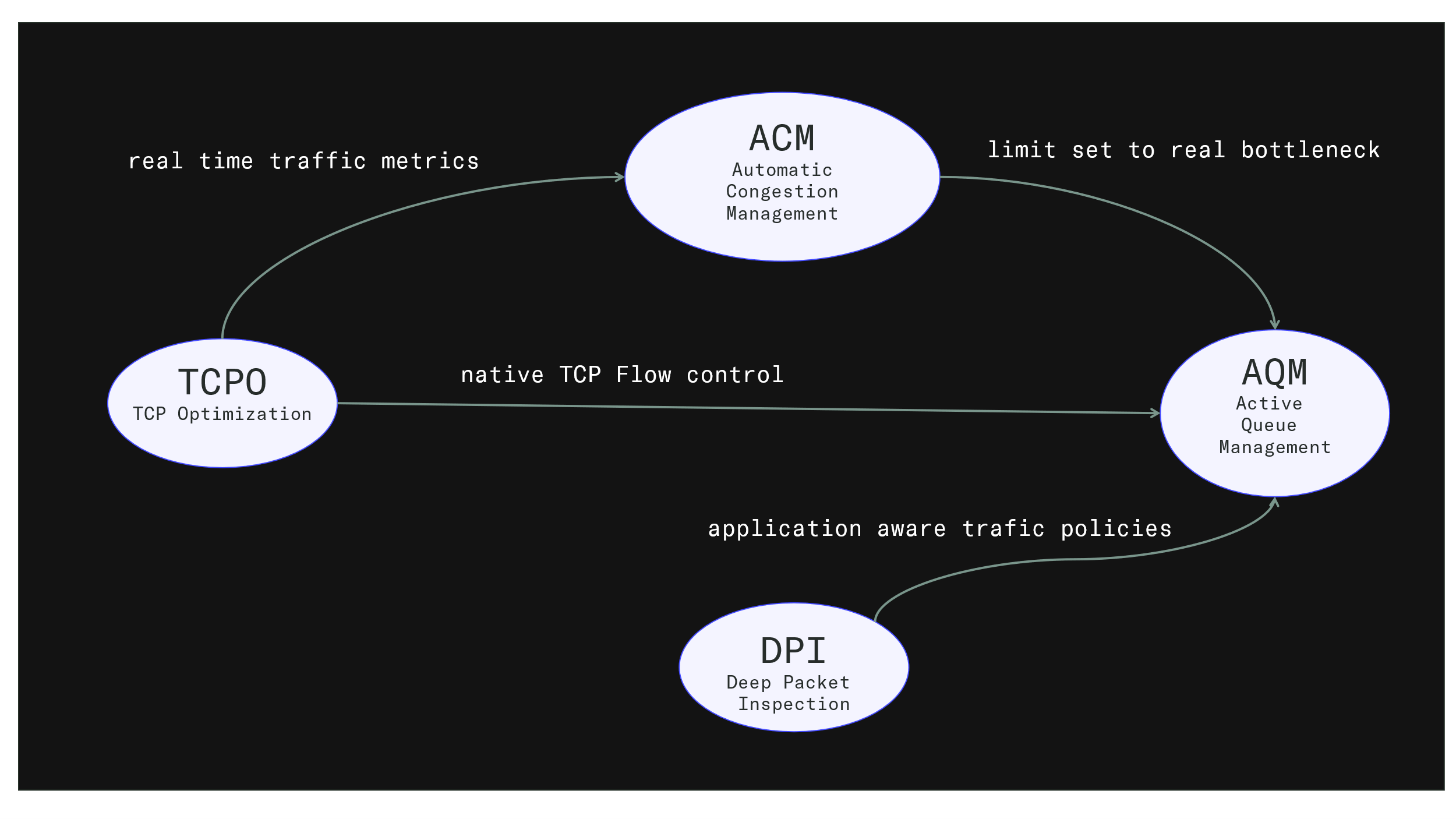
- TCPO optyimizes the dominant transport protocol and hands ACM trustworthy speed, latency, acknowledgment and retransmission signals.
- ACM’s detection is only as good as those measurements. ACM in turn determines the rate at which AQM should be enforcing, so queue management operates against the real bottleneck instead of a nominal ceiling.
- AQM keeps flows isolated at that limit, and TCPO lets it hold the limit by adjusting TCP progression rather than by dropping packets, so the enforced rate is reached with less loss and fewer retransmissions.
- DPI sits above all three, deciding which applications should be prioritized or moderated inside the controlled environment the other three maintain.
Remove one element and the loop degrades everywhere, not only in the function that was removed.
What the combination delivers
The effect is measurable in production networks. In Cajun Broadband, and ISP in Louisiana, USA, congestion management cut latency by 83% and brought TCP retransmissions down from a high of 6.6% to an average of 0.32%. In another deployment, TCP Optimization raised average subscriber speed by 35,4%, increasing average TCP connection speeds from 3.1 Mbit/s to 4.2 Mbit/s. Those are results of the same architecture seen from two angles — one measuring the removal of queueing delay and loss, the other measuring improved throughput — and both are visible in the platform’s own statistics rather than in synthetic tests.
The state of the art
All four functions are inline, per-subscriber, per-flow capabilities that must operate at line rate and adapt continuously. Most bandwidth-management products implement a subset: shaping and queueing are comparatively simple, while a full inline TCP implementation and machine-learning congestion detection are not, which is why few vendors offer them at all. An ISP evaluating this space is therefore not choosing between features but between architectures — one that manages bandwidth against a configured number, and one that measures the network continuously and applies the most advanced technology to extract the best performance that the network can deliver. The four functions are the components of this second architecture, and they are strongest when all four are enabled together.