
The most advanced technology to maximize the quality of experience of your network subscribers.

Reduce support calls and truck rolls

Reduce customer churn

Gain new customers
We thought we were doing all we could with our original QoE solution, but after installing Bequant next-gen QoE our customer support calls dropped by 35%.
Results
Transform your bufferbloat network grade.
If your customers use the popular Waveform bufferbloat test, which will assign a grade to your quality in terms of its bufferbloat and its suitability for gaming applications, the Bequant QoE will provide a significant boost in the grade of your network.
QoE ensures better speed test results and less customer complaints.
600+ ISPs powered by Bequant QoE




























[TCPO] TCP Optimization
The Bequant TCPO increases the network speed experienced by end users.
Even first-class networks can stall when a home Wi-Fi router introduces stray packet loss. TCP and QUIC servers interpret those losses as congestion and throttle traffic to a fraction of the path’s true capacity. Bequant’s TCP Proxy — armed with our patented, next-generation congestion-detection algorithms — instantly separates random Wi-Fi noise from genuine
congestion and keeps every TCP flow cruising at the maximum rate the network can sustain. The payoff is simple: consistently higher throughput, snappier applications, and a visibly faster experience for subscribers.
Lorem Ipsum is simply dummy text of the printing and typesetting industry.
How BQN TCPO works
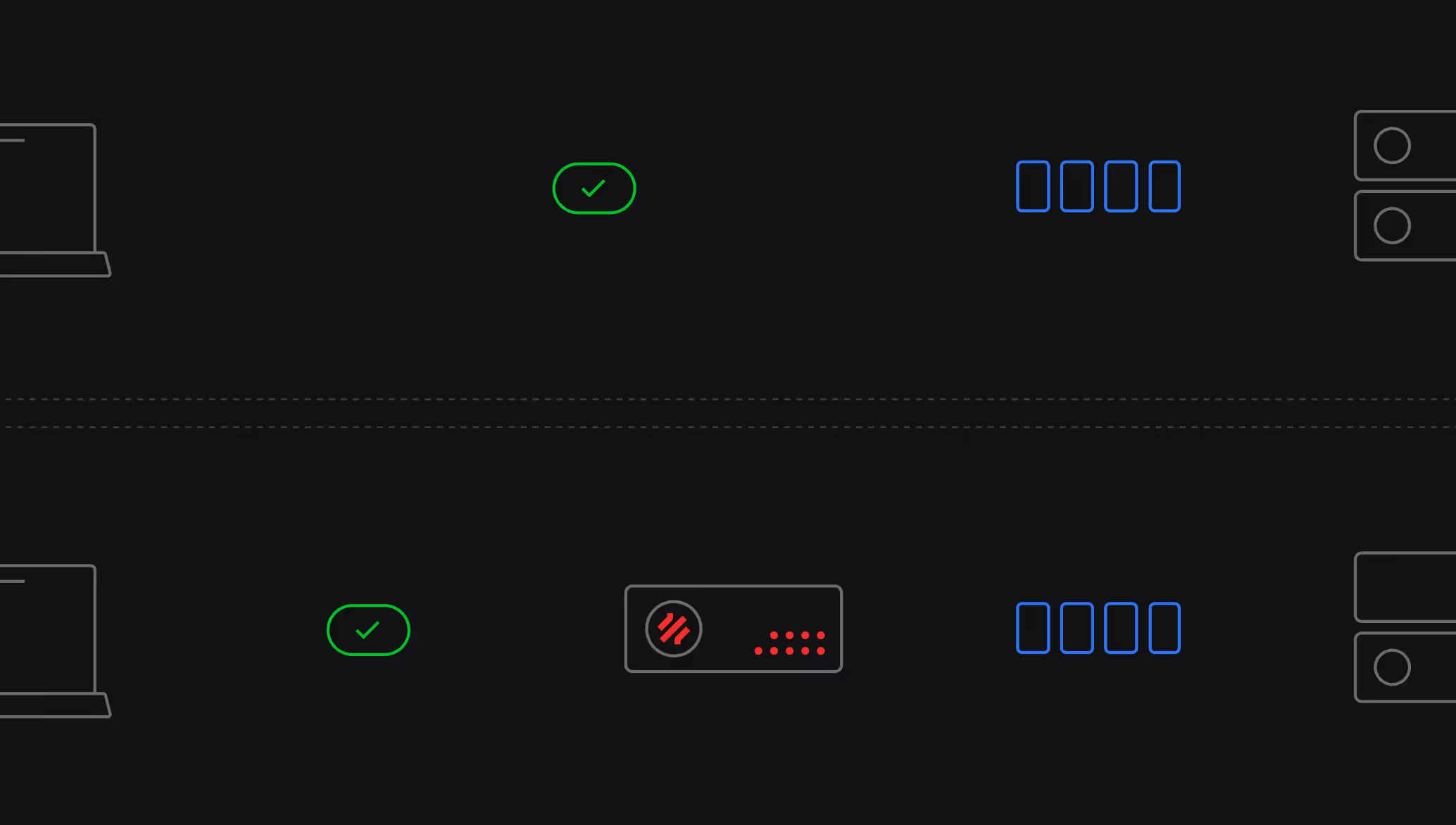
Detect congestion with a faster TCP Stack.
The Bequant TCP stack detects congestion based on the measured delivery rate, as described in our patent portfolio. Our improved congestion detection algorithm allows our TCP to be more aggressive when there is no congestion and to back off in real congestion, being able to carry out this discrimination in challenging environments: with shallow buffers, wireless links, packet losses or large network delays.
The following graph shows the reduction in the page loading time of several popular websites and applications, measured in a large mobile cellular network over one week with thousands of measurements.
Lorem Ipsum is simply dummy text of the printing and typesetting industry.
Comparing our TCP stack with Cubic, BBR & BBR2 TCP.
[ACM] Automatic Congestion Management
Reduce latency and packet loss originated by edge or customer premises equipment.
Even in the best networks, slow WiFi connection can trigger high latency and packet loss, disrupting gaming and video calls.
Bequant’s ACM uses machine learning to monitor each user's speed, latency, and packet loss in real time. It detects issues — even at speeds below the user's rate plan — and optimizes transmission to avoid them. Running from the network core, ACM reduces congestion from edge and in-home devices, improving QoE and lowering support calls. It’s also simpler and more cost-effective than managing performance at every endpoint.
We already had a solid QoE solution in place, but decided to take Bequant up on their 30-day trial — and we're glad we did! Our network latency dropped from 30 ms to 15 ms, and retransmissions fell by 80%. Bequant's team truly goes above and beyond!

[AQM] Active Queue Management
Bequant QoE reduces latency and packet loss, especially for interactive applications, with the most advanced queueing technology in the market.


Rate plans are implemented with the most advanced AQM in the market.
Limit rates without impacting online gaming and teleconferences.
Interactive applications, like online games and teleconferences, can be severely impacted by rate limitations in congestion, because of their high sensitivity to latency and packet losses. However, our unique multi-queue technology guarantees an independent queue for each connection.
Multiple queues ensure that interactive data do not have to wait in queues with heavy traffic, like video streaming. In this way, interactive applications will not notice the rate limitation, even in congestion situations.
Lorem Ipsum is simply dummy text of the printing and typesetting industry.
DPI/App-based Prioritization
Avoid support calls with guaranteed speed test rates and prioritize flows from sensitive applications.
FAQ
How is active queue management (AQM) different from traditional rate limiting or traffic shaping?
All three enforce or react to a traffic rate, but they treat the queue very differently:
- Traditional rate limiting (policing) drops every packet that exceeds the configured rate, without buffering. The plan is enforced, but the heavy induced loss makes transport protocols back off sharply, so throughput oscillates and the subscriber rarely sustains the nominal speed.
- Traffic shaping buffers excess packets in a queue and releases them at the configured rate. It is smoother than policing, but with a deep, unmanaged queue the queue depth grows during congestion and latency explodes (bufferbloat), which subscribers notice in games, video calls and teleconferences.
- Active queue management acts on the queue itself: it monitors queue depth and proactively drops or ECN-marks selected packets before the queue fills, so flows slow down smoothly instead of collapsing. The result is rate-plan enforcement with consistently low latency and packet loss.
Bequant implements an advanced AQM with per-subscriber policy enforcement, flow delay isolation, interactive flow prioritization and native TCP flow control. Bequant Automatic Congestion Management (ACM) dynamically detects bottlenecks and instructs the AQM to kick in, keeping latencies low and interactive services responsive in most network conditions.
Why are subscribers seeing slow speeds even when my network has enough bandwidth?
Deployed bandwidth capacity does not guarantee fast effective speeds: an advanced bandwidth management product is needed. What follows is a short description of the main causes of capacity underutilization and performance degradation and how Bequant tackles them:
- An application, for example a speed test or a video stream, runs at whatever rate its individual flows can sustain end to end, not at the rate of the core network. One of the causes is that TCP congestion control treats packet losses as congestion signals and backs off when it detects one, so a single impaired hop with random losses will cap the flow's rate while network capacity goes unused. Bequant addresses this with its transparent TCP optimization proxy (TCPO), which handles random losses far more efficiently.
- Network elements usually have internal queues to store traffic packets while they are processed. When the equipment is the bottleneck (e.g. a shaper enforcing the rate plan), the queues can grow too much and cause an excessive queue depth (bufferbloat). This increases the latency experienced by the subscriber, which can be quite noticeable in interactive applications like games and teleconferences. Bequant provides Active Queue Management (AQM) that prevents bufferbloat and minimizes delays in interactive applications, for an optimal customer experience.
- The speed a subscriber experiences is the speed of the bottleneck of the traffic path, which is not always their nominal rate plan speed. Common bottleneck examples include in-home Wi-Fi, a busy wireless sector or an oversubscribed OLT. The bottleneck location changes from time to time, as does the maximum speed at which it operates. Bequant Automatic Congestion Management (ACM) detects those bottlenecks in real time and activates the AQM rate limiting, to keep losses and latencies low during congestion episodes.
How can an ISP implement fair usage policies without degrading quality of experience?
You need to apply fair usage policies based on actual network bandwidth limitations. This will not degrade but improve the QoE for most users.
For example, if a segment of your network has a backhaul link that gets saturated during peak-hours, you can use Bequant traffic management to set a limit for the most bandwidth-hungry applications (e.g. video streaming), and a global rate limitation with scheduling that guarantees a minimum bandwidth for all users. As a result, the QoE of the customers served through that link will improve.
In the end, when well implemented, fair-usage policies allow you to share a limited bandwidth between many users while improving their quality of experience.
Why does centralized subscriber policy management scale better than manual queue configuration?
Managing subscriber policies in a centralized node scales better as traffic grows because a product like Bequant has bigger capacity, it is more economical to deploy and easier to maintain.
Regarding bigger capacity, Bequant uses Intel/AMD server with faster CPU and memory than router hardware and its internal architecture is optimized for policy management. An added benefit is that Bequant sees all traffic and can apply network-wide fair use policies using very simple rules.
Regarding deployment, one single powerful hardware can be much less expensive to acquire and roll out than many smaller ones, including the interaction with a RADIUS or billing system to get the policies from.
Finally, a distributed solution is cumbersome to maintain, because each element will have its own queue configuration to keep coherent with the rest.
When is traffic optimization more cost-effective than purchasing additional network capacity?
In most cases, additional network capacity will not deliver any gains, because the speed is mostly limited by the access network and the Wi-Fi last hop. Bequant traffic optimization features (TCPO, ACM, AQM, etc.) will reduce congestion in those network elements and improve the quality of experience in a way that an increase in network capacity will not deliver.
An example of this is Cajun Networks, who has reported 83% reduction in latency and retransmissions going down from a high of 6,6% to an average of 0.32% just deploying Bequant, without any network capacity expansion.
You can request a Bequant free trial on BQN Free Trial Application Form.
What is application-aware traffic shaping, and how does it protect latency-sensitive services such as gaming, voice and video calls?
Application-aware traffic shaping is a network management technique that identifies the type of application generating traffic (gaming, VoIP, streaming, large downloads, etc.) and then dynamically prioritizes the flows based on that identification. Bequant implements application-aware traffic shaping in two ways:
- Deep-packet-inspection (DPI): identifies the traffic to apply configured policies. One example is the identification of video streaming during peak hours to moderate its demand.
- Prioritization of interactive flows: Bequant automatically identifies interactive flows by their behavior and prioritizes them in the AQM. This requires no explicit policy configuration.
Can traffic-management software automatically use billing-system data to enforce subscriber plans?
Yes, Bequant can enforce per-subscriber traffic policies interacting with the billing system. Bequant is currently integrated with 20 vendors so far and growing. The billing vendors include:
- Aradial
- Azotel
- Gaiia
- Gestfy
- HubSoft
- ISPCube
- ISP Gestión
- ISPSolution
- IXC
- Mikrowisp
- Phicus
- Powercode
- Sonar
- Splynx
- UISP
- Vision by Fibersmith
- Visp.net
- WISPControl
- Wisphub
- Wispro
More information can be found on BQN integrated Billing Systems.
How can a small ISP manage per-subscriber traffic policies with limited engineering resources?
Bequant can enforce per-subscriber traffic policies with very little work by the network engineering team. Bequant can get policies or plans automatically from RADIUS signaling, interacting with the billing system (20 vendors so far and growing) or getting them via Bequant REST API.
Bequant AQM automatically detects and prioritizes interactive flows such as teleconferences or gaming, and its AI congestion mitigation (ACM) is self-learning and does not require manual fine tuning. The manual policies can be much simpler and stable, freeing engineering time.
Bequant improvement of subscriber QoS reduces support calls, further alleviating network engineering workload. Chadd Giles, CTO of Resound Networks, reports a 35% drop in support calls.
What are the limitations of router ACLs or router-based queues for subscriber plan enforcement at scale?
Routers run an optimal packet fast path for core routing functionality and a less optimal path for ACL processing or QoS queues. In many models, just activating those features increases the CPU load and memory usage and reduces the throughput capacity. The impact becomes bigger as more entries are added.
In Bequant, our optimal path involves traffic classification, queues and policy enforcement because traffic management is our core functionality. Bequant incorporates technology such as DPDK to obtain optimal performance.
Bequant runs on off-the-shelf Intel or AMD servers, which typically have faster CPU and memory than router hardware. Thanks to superior hardware and implementation, Bequant supports very high throughput, up to 400 Gbps in one single server.
More information can be found on BQN Platform.
How do ISPs enforce subscriber bandwidth plans without overloading routers?
You can prevent routers from being overloaded by offloading subscriber plan enforcement to Bequant traffic management system. At the core of Bequant architecture sits an advanced queue management (AQM) built to scale. Bequant runs on off-the-shelf Intel or AMD servers and supports very high throughput, up to 400 Gbps in one single server.
More information can be found on BQN Platform.
How can an ISP reduce network congestion and improve subscriber quality of experience without adding capacity?
Bequant detects network congestion and manages the network capacity while improving the subscriber quality of experience. Keeping QoE constant, the network can accommodate more subscribers. Anibal Enríquez, CEO of Communicate, has reported 10% more users per Access Point.
Keeping the number of subscribers constant, the subscriber QoE is improved by reducing the network latency and losses. Cajun Networks has reported 83% reduction in latency and retransmissions going down from a high of 6,6% to an average of 0.32%.
Bequant traffic AI congestion mitigation (ACM) mitigates the congestion, active queue management (AQM) enforces rate limits in an optimal way and application-based traffic policies (DPI enabled) moderate the demand of heavy applications during peak hours.
More information can be found on Cajun Case study and Enhanced Subscriber QoE.