Optimal Bandwidth Management When the Bottleneck Is Not the Subscriber Plan
How Bequant Automatic Congestion Management detects and mitigates each subscriber’s real bottleneck

Abstract. Bandwidth management normally starts with a configured subscriber rate: the shaper knows the rate limit to enforce and builds a queue around that ceiling. In many networks, however, the real bottleneck often sits below that nominal limit, and the shaper — no matter how advanced its AQM — does not come into play. Bequant Automatic Congestion Management (ACM) addresses that problem. It continuously observes each subscriber’s delivered rate, latency, and packet-loss behavior, detects the onset of congestion with machine-learning logic, and controls the sending rate so that traffic remains close to the maximum sustainable throughput while queueing delay and retransmissions stay low. The result is a closed-loop, subscriber-aware bandwidth-control function that can operate under all network conditions, even without knowing the contractual plan limits.
The operational problem
Traditional per-subscriber shaping assumes that the network knows the upstream and downstream rate plan limits. That model is effective when the plan is the limiting factor, but it does not address the common situation in which the actual traffic path is slower than the nominal plan limit, for example during network congestion or when an access link is saturated.
The point is that the contractual rate and the instantaneous bottleneck are not always the same. A subscriber sold 100 Mbit/s may temporarily be constrained to 45 Mbit/s by a busy wireless sector, a weak Wi-Fi link, an oversubscribed access node, or another downstream device. A shaper configured to enforce the subscriber plan never engages, and its Active Queue Management (AQM), no matter how advanced, plays no role. And higher subscriber rate plans, like 1 Gbps, are very seldom reached, with speeds being limited by WiFi or access network limitations. Optimal management therefore requires the controller to infer the rate the path can sustain now, not merely apply the nominal rate of the subscriber plan. That requires the identification of external bottlenecks.
ACM turns bandwidth management into a feedback-control problem
BQN is deployed inline and can therefore observe the traffic delivered to each subscriber. ACM continuously monitors subscriber speed, latency, and packet losses. Instead of requiring a pre-provisioned ceiling, it treats rising delay and loss as signals that the load is exceeding the capacity of the current bottleneck. Machine-learning algorithms evaluate those signals in real time and derive an operating rate for that subscriber.
- Observe: measure delivered throughput, latency, and loss continuously for the subscriber.
- Detect: identify the characteristic change that indicates persistent queue growth or another congestion condition.
- Estimate: infer the presently sustainable rate, even if no external system has supplied the plan.
- Mitigate: regulate the sending rate before uncontrolled buffers accumulate excessive delay and trigger avoidable loss.
- Adapt: keep measuring and move the operating point as radio conditions, access load, or downstream capacity change.
Conceptually, ACM seeks a rate r close to the unknown available capacity C, while constraining queueing delay and loss. If r persistently exceeds C, the queue grows; ACM detects the resulting congestion signals and reduces the controlled rate. If conditions improve, it can allow more traffic. Because the loop is driven by observed path behavior, the unknown subscriber plan is no longer a prerequisite for effective bandwidth management.
Why ACM complements—rather than duplicates—AQM
BQN Active Queue Management (AQM) is highly effective at enforcing a known rate limit: advanced per-flow queueing avoids the long queues that create bufferbloat and prevents interactive traffic from waiting behind heavy transfers. But AQM is tied to knowing the rate limit to enforce. It cannot by itself eliminate a queue forming in a slower external node when that node’s capacity falls below the configured plan.
ACM closes this gap. It detects congestion below the subscriber plan, including bottlenecks such as a slower Wi-Fi router, and automatically instructs the AQM to apply the effective rate limit. Working together, ACM and AQM enforce both the commercial ceiling and lower, time-varying bottlenecks. Even when plans are unknown, ACM can automatically detect effective limits and make the Bequant AQM the bandwidth-management element.
Deployment and validation
Because ACM is enabled by default and is designed to improve quality without configuration fine-tuning, an operator can begin with the automatic control loop and add external subscriber-plan integration later. BQN can obtain subscriber data from RADIUS, REST APIs, and supported billing connectors, so unknown-plan operation does not prevent a later transition to complementary plan enforcement.
Validation should focus on network-quality outcomes rather than rate alone. The BQN interface exposes ACM and congestion statistics, including the percentage of traffic where congestion is detected, latency over time, and average TCP retransmissions over time. The same views are available per subscriber, making it possible to confirm that the controller is acting where congestion occurs and that delay and retransmission improve after mitigation.
Case study — BQN impact in Cajun Broadband
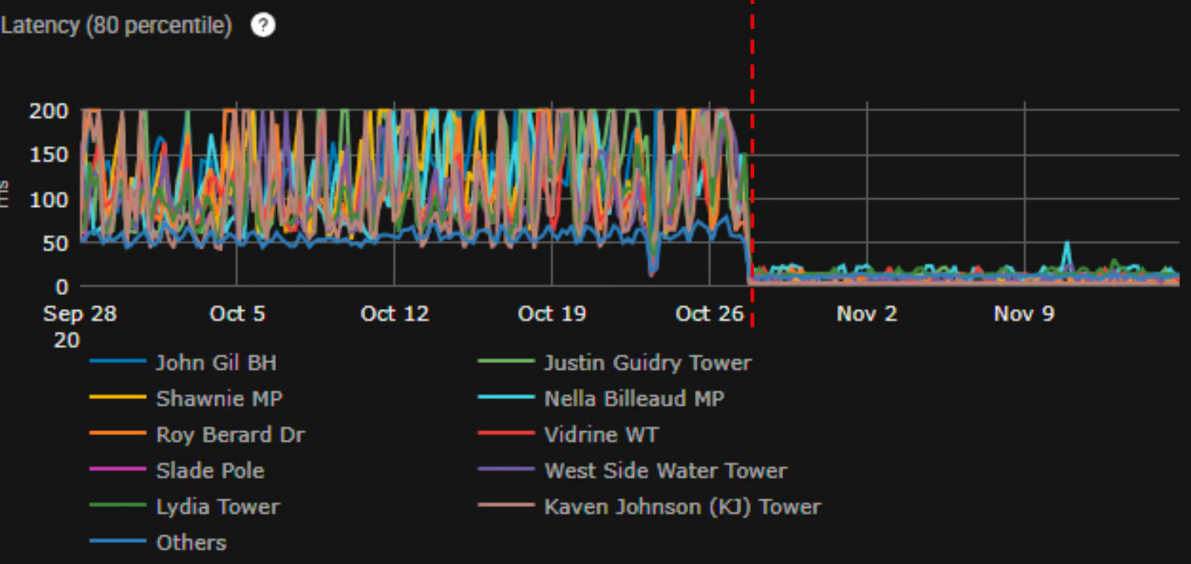
A directly applicable Bequant example is Cajun Broadband, an ISP in Louisiana, USA, which has reported an 83% reduction in latency, with retransmissions falling from a high of 6.6% to an average of 0.32%.
Conclusion
BQN ACM makes optimal bandwidth management possible when real bottlenecks sit below subscriber plan nominal limits. It observes each subscriber, detects congestion from real path behavior, estimates the sustainable operating point, and invokes the BQN AQM to mitigate the overload before queues produce excessive latency and loss. In short, subscriber plans define commercial intent; ACM continuously discovers the rate that delivers the best achievable Quality of Experience (QoE) under current network conditions. So, in a network being limited by a congested WiFi router over which the network provider has no control, ACM will be able to detect that rate limitation and avoid the latency and losses that would otherwise produce a low Quality of Experience for the end user.