Resound Improves Speeds After Bequant QoE Implementation
Resound Networks, a leading Fixed Wireless Access (FWA) provider serving rural and underserved communities across the U.S., achieved a marked improvement in subscriber network performance by implementing Bequant’s Quality of Experience (QoE) optimization software. Following a strategic deployment starting in Q1 2024, Resound saw significant increases in median download and upload speeds, alongside a dramatic reduction in customer support tickets.

Background & Challenge
In the rapidly evolving broadband landscape, WISPs face intense competition from LEO satellite constellations and large telcos. While Resound Networks had built a robust FWA footprint across Texas, New Mexico, Arkansas, Arizona, and Oklahoma, the challenge lay in maximizing the potential of their existing spectrum. Operating in shared spectrum environments, Resound faced the typical hurdles of congestion and interference, which could degrade performance as data consumption surged.
In early 2024, Resound adopted Bequant’s QoE network optimization platform. The initial rollout targeted core network data centers, followed by a strategic expansion into Albuquerque, Phoenix, Dallas, Houston, and Oklahoma City. The goal was to optimize subscriber traffic flows between the network core and the subscriber’s device, ensuring consistent performance even during peak usage.
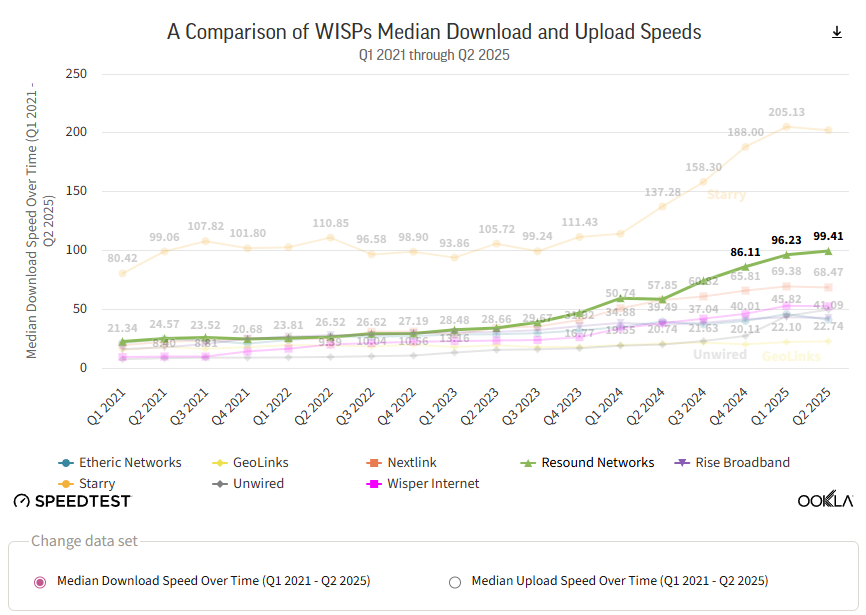
The timing of this deployment proved pivotal. In November 2025, Ookla, an Accenture company, a global leader in connectivity intelligence, specializing in broadband testing, network diagnostics, and performance analytics, released its WISP Report Card, measuring performance between Q1 2021 and Q2 2025. The report highlighted a distinct inflection point in Resound’s performance metrics that correlated directly with the Bequant implementation.
Technical Drivers for Success
The data presented in Ookla’s report reveals a clear trajectory of improvement for Resound Networks. Resound’s leadership attributes this success to specific technical capabilities within the Bequant platform:
- TCP & ACM Optimization: By optimizing Transmission Control Protocol (TCP) handshakes and Auto Congestion Management (ACM), the system ensures data packets are delivered more efficiently, reducing latency and retransmissions. This is critical in FWA environments where radio conditions fluctuate and in-home Wi-Fi cause additional unpredictability.•
- Bandwidth Management: Smart traffic shaping prevents congestion at the tower level and in-homes, ensuring fair and consistent speeds for all subscribers even during streaming video peak usage times.
- Network Visibility: Deep packet inspection and granular visibility allow Resound to identify bottlenecks and optimize resource allocation dynamically.
Results
Key Insight: Aside from Starry, which targets MDUs in five major metropolitan areas primarily using millimeter wave spectrum, Resound leads the other traditional rural and suburban WISPs cited in the report, meeting the FCC’s minimum requirement of 100/20 Mbps for more than 41% of its customers. Resound’s Network performance has continued to improve, and by Q2 2026, it delivered the FCC requirement to 53% of Speedtest users. This is a significant advantage in a market where many FWA competitors struggle to get 30% of users to that threshold.
Speed Growth Trajectory
Median download speeds jumped from 39 Mbps in Q3 2023 to over 99 Mbps in Q2 2025, with the steepest growth occurring after the Q1 2024 QoE deployment.
Optimized Services
Fixed wireless or otherwise, an ISP’s top traffic demand is streaming video, especially at peak time after the working day and on weekends. Resound applied Bequant’s traffic shaping to all streaming video to both: 1) ensure a buffer-less experience for streamers; and 2) control the bursty peak load caused by the demanding video players.
Reduced Support Calls
With speed test results assured through another QoE traffic flow rule and streaming video traffic under control, the load on Resound’s support center eased. Resound’s CTO, Chadd Giles, noted, "After installing Bequant next-gen QoE, our support calls dropped drastically." This reduction in tickets translates to significant cost savings and higher subscriber satisfaction, proving that network efficiency drives business value.
Leadership Insights
Resound’s VP of Software Development, Jeff Cortez, stated that the correlation between the deployment and the performance spike is not coincidental but, in fact, causal. The optimization software directly addressed the congestion that previously capped speeds.
Conclusions
The Resound results serve as a powerful proof point for ISPs of all access technologies.
Whether you operate a fiber network, a hybrid fiber-coax (HFC) system, or fixed wireless, the principles of network optimization remain universal – especially when the end user correctly assumes their unpredicatable in-home Wi-Fi network is their service provider’s responsibility.
Specifically for WISPs, as spectrum becomes more congested and competition from satellite providers intensifies, optimizing the existing infrastructure is often the most cost-effective path to superior performance.
Resound’s journey demonstrates that with the right tools, non-fiber networks can not only compete but thrive. By adopting QoE optimization, ISPs can deliver speeds that meet or exceed FCC benchmarks, reduce operational costs, and future-proof their networks against the next wave of competition.
At a Glance: Resound
Resound Networks, a leading Fixed Wireless Access (FWA) provider serving rural and underserved communities across the U.S., achieved a marked improvement in subscriber network performance by implementing Bequant’s Quality of Experience (QoE) optimization software. Following a strategic deployment starting in Q1 2024, Resound saw significant increases in median download and upload speeds, alongside a dramatic reduction in customer support tickets.
Ookla’s WISP Report Card (November 2025) highlights Resound’s steady network performance improvements since adopting Bequant’s QoE network optimization platform. In Q2 2025, Resound delivered the FCC’s minimum requirement for broadband speeds of 100/20 Mbps to more than 41% of Speedtest users. Network performance has continued to improve, and by Q2 2026, Resound delivered the FCC requirement to 53% of Speedtest users.
"When we started activating flows for streaming services and when we started putting lower prioritization during busy hour for software updates, we really started to see overall better customer experience for their traffic."
Jeff Cortez, VP of Software Development, Resound Networks
At a Glance: Ookla
Ookla, an Accenture company, is a global leader in connectivity intelligence that brings together the trusted expertise of Speedtest®, Downdetector®, Ekahau®, and RootMetrics® to deliver unmatched network and connectivity insights. By combining multi-source data with industry-leading expertise, Ookla helps wireless internet service providers (WISPs) like Resound Networks transform network performance metrics into strategic, actionable insights to better serve their customers.
"Validating network performance and meeting or exceeding FCC requirements is critical to the success of WISPs. Our WISP report card helps providers, such as Resound Networks working with Bequant’s network optimization platform, highlight network performance improvements and improve customer satisfaction."
Chip Strange, Chief Strategy Officer, Ookla