Solving the In-Home Wi-Fi Challenge in FTTH Networks
Fiber-to-the-Home delivers ultra-fast speeds, but the subscriber's experience often falters beyond the ONT—inside the home, where unmanaged Wi-Fi introduces variability the ISP can't directly see or control. This brief explains why in-home Wi-Fi is so unpredictable, why ISPs get blamed for problems they can't monitor, and how a centralized QoE approach solves the issue at the network core. By deploying Bequant's BQN software upstream of the OLT, ISPs gain network-wide visibility and control—improving streaming, gaming, and conferencing quality without deploying costly hardware in every home.
Background: The Hidden Challenge in FTTH
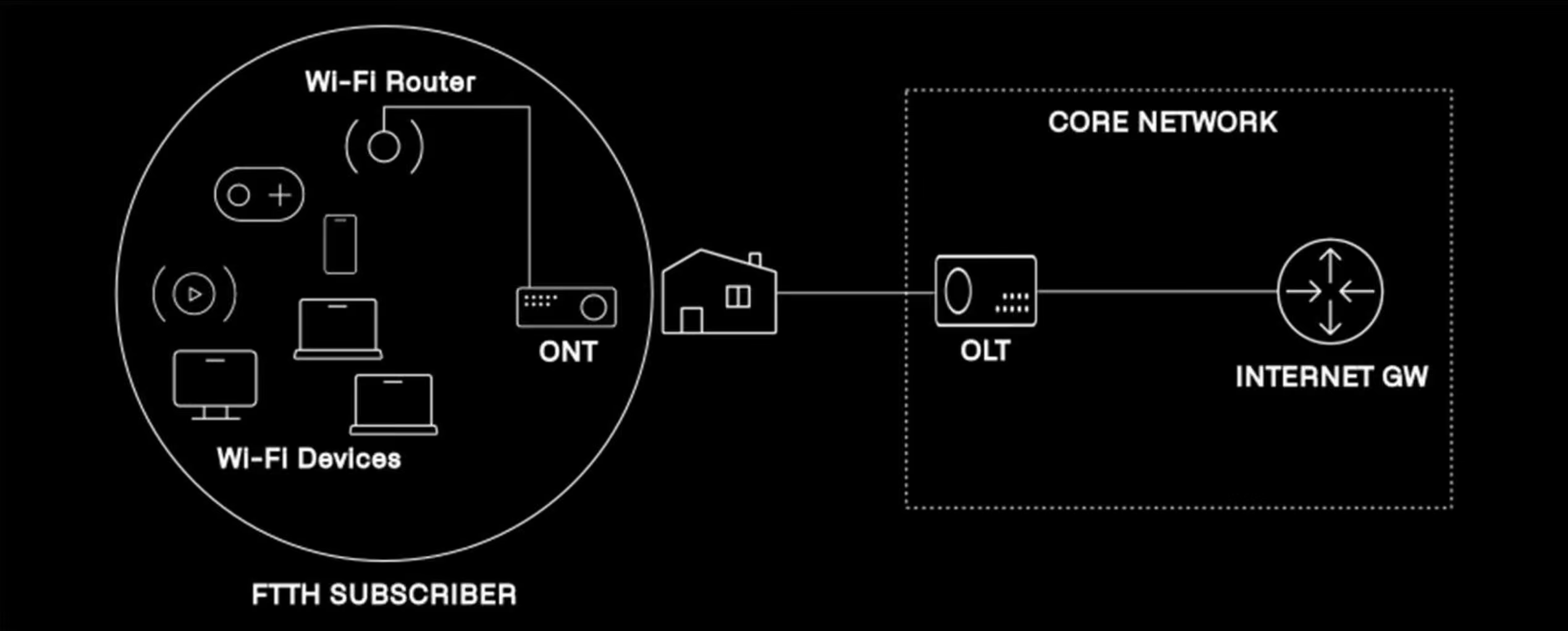
Fiber-to-the-Home (FTTH) Internet Service Providers (ISPs) deliver ultra-fast, low-latency connectivity through Gigabit Passive Optical Network technology (GPON or XGS-PON). While the ISP's core network and Optical Line Terminal (OLT) provide reliable performance up to the Optical Network Terminal (ONT) in customers' premises, the subscriber's experience often falters beyond that point. This is because the network environment shifts from the ISP's controlled infrastructure to an uncontrolled domain.
Two major factors outside the ISP's direct control impact a subscriber's Quality of Experience (QoE):
- External connections to content servers such as Netflix, Hulu, Paramount, gaming servers, or video conferencing services like MS-Teams or Zoom; and
- In-home Wi-Fi performance in the access network, where most end-user frustrations originate.
This brief focuses on the in-home Wi-Fi environment, where ISP support teams are often blamed for problems that they cannot directly see or control.
Why Wi-Fi Is So Unpredictable
While fiber provides consistent low-loss and high performance, Wi-Fi introduces variability due to its dependence on radio signal levels & noise, device compatibility, and environmental conditions: both radio frequency (RF) and structural. Customers expect seamless connectivity, but the wireless environment is highly sensitive to interference and competing demands.
Five Sources of Wi-Fi Performance Inconsistency
- Neighbors and Interference
Surrounding residences’ Wi-Fi and non-Wi-Fi devices compete for available RF spectrum unless coordinated. - Home router bufferbloat
Over-sized packet buffers result in undesirable latency, jitter and TCP retransmissions. - End device location relative to wireless router location
Impacts signal level, signal quality, RF modulation and ultimately link speed and quality. - In-home devices competing for a shared medium
RF channel utilization impacts Wi-Fi client packet timing and ultimately throughput, latency & retransmissions. - End device Wi-Fi behavior
The combination of in-home Wi-Fi clients’ technology (Wi-Fi 5, 6, 6E), band, and channel widths impact any one client’s performance.
The typical US home has 20-25 Wi-Fi devices and a typical Wi-Fi router can cover 800 to 2000 square feet indoors. Factors affecting in-home Wi-Fi performance include:
- Wi-Fi router placement, quality, and technology. The router could be ISP-supplied and provisioned but could also be one or more Wi-Fi 5, 6, 6E, 7 or even legacy Wi-Fi 4 Wireless Access Points distributed inside and/or outside the residence in a star or mesh topology. The placement and orientation of these nodes impact in-home Wi-Fi coverage and quality.
- Wi-Fi device technology and operating band. Older Wi-Fi clients are limited to earlier (read, slower) Wi-Fi technologies. When they communicate over the shared RF channel, other devices cannot and buffering begins.
- Wi-Fi-connected applications competing for consistent network performance. These are the subscriber's devices needing internet connection like:
- Laptops for general web browsing, teleconferencing, and video streaming
- Video streaming devices & smart TVs with embedded streaming capabilities
- Smartphones for web browsing, streaming or VoIP-over-Wi-Fi calling
- Voice-controlled smart speakers
- Gaming consoles
- IoT devices like smart thermostats and lighting controls. Although not high-demand with respect to bandwidth, latency or jitter, they typically communicate using older, lower cost, and low-power Wi-Fi or Bluetooth.
- Laptops for general web browsing, teleconferencing, and video streaming
- Physical environment: Wi-Fi quality can depend on the residence's building age & construction. As a Wi-Fi client and router increase physical separation or move across signal-impeding walls, signal levels decrease and network speeds slow as the Wi-Fi system lowers it RF modulation to maintain the connection.
- Neighboring RF interference. Rarely are the RF channels coordinated so Wi-Fi routers/WAPs in adjacent apartments, condos, or homes can cause co-channel or adjacent-channel RF interference with your subscriber's Wi-Fi, degrading performance further.
- Non-Wi-Fi RF interference may come from Bluetooth devices and microwave ovens (2.4GHz) and wireless cameras.
Network Sensitivity of Applications
The Result: Even with fiber speeds up at the ONT, customers may still experience streaming video buffering, dropped or stuttering VoIP & teleconferencing calls, and laggy gaming.
From the Customer Perspective:
It's an ISP's issue: your subscribers don't separate fiber quality from Wi-Fi quality.
The Real Issue for ISPs
From the ISP's perspective, the in-home environment is a blind spot that generates support calls and operational headaches. Although customers blame the ISP, the root cause often lies in unmanaged and unseen Wi-Fi issues.
Key challenges include:
- Support Burden: Most ISP support calls are Wi-Fi related.
- Lack of Visibility: ISPs cannot see key KPIs like throughput, latency, TCP retransmissions of the end-to-end network traffic or they won't heavy subscription costs for that visibility.
- Customer Perception: Subscribers don't separate fiber quality from Wi-Fi quality.
- Business Impact: Poor Wi-Fi experience can lead to customer churn, bad reviews, brand damage, and excessive & costly service truck rolls.
Bottom Line:
You cannot manage what you do not monitor.
A Smarter Solution: Centralized QoE Optimization
Traditional approaches to solving Wi-Fi problems involve continuously upgrading in-home routers or deploying mesh AP kits, but these methods only solve issues in individual homes in the moment and create recurring hardware costs. A more effective, scalable solution is to optimize quality at the network core.
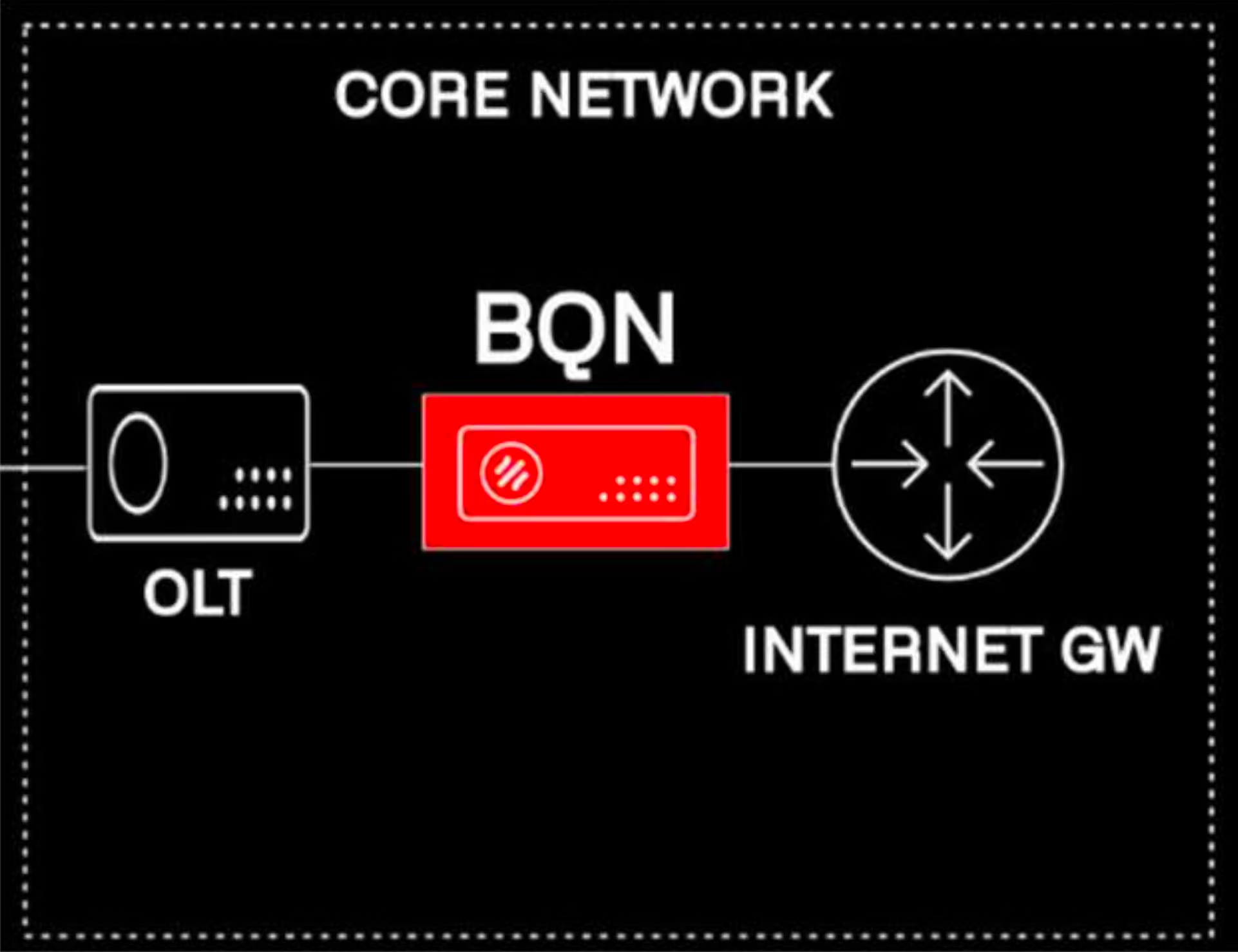
Deploy a centralized QoE appliance upstream of the OLT with all FTTH traffic flowing through this server-grade device, powered by Bequant software (BQN).
How It Works
Operating in-line on an ISP-supplied server hardware at the network core, Bequant's BQN software provides ISPs with insights and controls essential to overcome limitation imposed on their network by in-home Wi-Fi.
Here's a list of BQN functions:
- TCPO — TCP Optimization. Acting as a transparent TCP proxy between content servers and end-user device traffic flows, Bequant's patented TCPO algorithms reduces retransmissions & latency and accelerate TCP traffic.
- DPI — Deep Packet Inspection. Enables application identification to provide network visibility and is used by our bandwidth management.
- ACM — Auto-Congestion Management. AI-powered congestion detection and mitigation per individual customer, even when plan limits are unknown or not reached.
- AQM — Active Queue Management. Minimizes latency during peak usage by creating queues per subscriber and per application flow with automatic prioritization of 2-way interactive traffic, teleconferencing, gaming, and other latency-sensitive applications.
- Bandwidth Management — Combined with AQM, enables the most flexible allocation of network resources and provides the best possible QoE. Rate limitations at different levels: per flow, DPI-policy, application flows, user, user group, or network element.
- Network Visibility — Leveraging DPI, obtain deep subscriber KPI. Real-time and historical metrics at user, group and network level, for better and more proactive customer support.
- App-based Prioritization — Prioritize time-sensitive apps like video conferencing. Offer non-blocking 4K streaming video at peak times even when other subscriber's devices are performing massive software downloads.
- Speed Test Optimization — Allows speedtests to use all available network capacity to reach subscriber's rate plan, even in the presence of background applications.
- Billing System Integration — Synchronize and enforce rate plans in BQN along with performing network optimization.
- Scalability — From 1 Gbps up to 400 Gbps in a single server. Manage multiple BQN servers as a cluster.
Another Alternative: Smart CPE in Every Home
Some ISPs consider placing advanced CPE devices into every subscriber's home to collect Wi-Fi performance metrics. While this offers reasonable but limited visibility, it is a less efficient model compared to a centralized QoE optimization.
The drawbacks of a distributed approach include:
- High hardware costs and high recurring OEM subscription costs.
- Complexity of potentially managing varied hardware, software, and firmware versions across the subscriber base.
- Difficult to correlate network performance issues across the network.
- Slower to scale with potential for pushback from "BYOD"-type subscribers.
- Constant and fast-paced evolution of Wi-Fi standards make upgrading all Wi-Fi routers to the same brand and technology difficult, complex, and capital-intensive.
Bequant Benefits for ISPs
By adopting centralized QoE optimization, ISPs gain network-wide visibility and control without deploying costly hardware in every home. This allows them to improve service delivery while reducing operational strain.
Key benefits include:
- Reduce OpEx by reducing support costs and effort:
- Resolve issues faster with real-time and historic KPI insights.
- Reduce truck rolls by providing more in-depth statistics and analytics right from your support desk.
- Be Proactive: Spot and address recurring poor subscriber KPIs and address before the churn.
- Improve Customer Satisfaction: Reliable streaming, gaming, and conferencing.
With over 600 installations across the globe, Bequant is deployed in many access technologies, not just FTTH.
Operators of any access network can benefit; many Wireless ISPs (WISPs) already have. Our QoE software can benefit any broadband technology: Fixed Wireless Broadband (FWB), Hybrid Fiber-Coaxial (HFC), Satellite, and 5G Fixed Wireless. In addition, Managed Service Providers offering Wi-Fi internet services to multi-dwelling units (MDU) can also benefit from smoother video streaming and more consistent teleconferencing experiences.
Summary
FTTH is powerful, but unmanaged Wi-Fi undermines customer experience. By placing intelligence at the network core, ISPs can bridge the gap between their fiber infrastructure and the subscriber's daily reality.
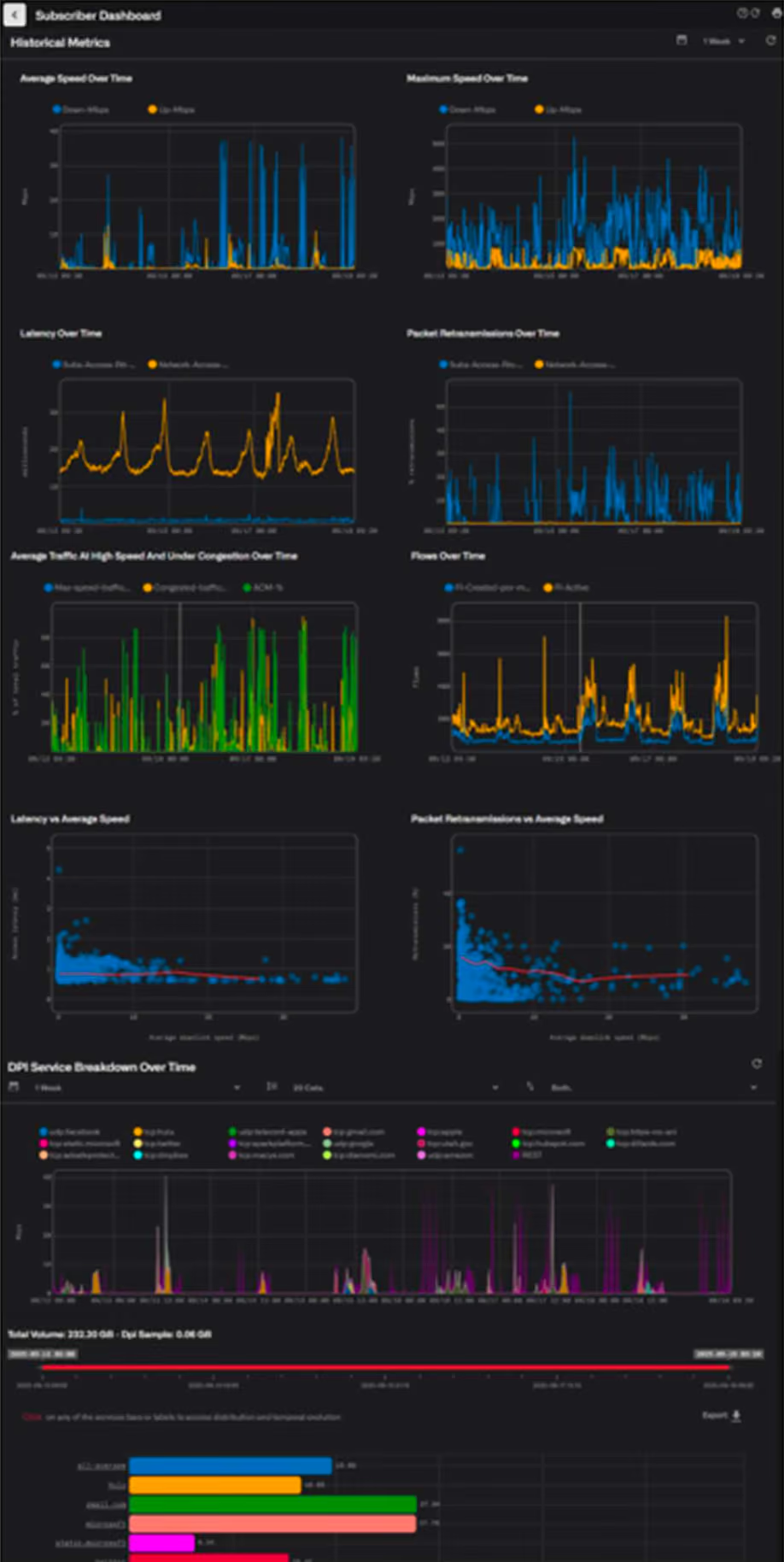
Bequant's centralized QoE solution enables ISPs to:
- Monitor, manage, and optimize subscriber QoE.
- Cut costs and improve customer experience.
- Compete on service quality, not just speed.
The Time to Act Is Now
Deliver the fiber speeds customers expect – and the Wi-Fi experience they demand.
Subscribers are judging their ISP on Wi-Fi quality as much as on delivered speeds. With Bequant's QoE solution, ISPs can take control of the in-home experience without deploying costly hardware in every home.
- Talk to Peers: Ask Bequant customers about their results.
- Try It Yourself: Request a 30-day, no-cost, no-pressure trial.