Why TCP Optimization: Its Many Contributions to Quality of Experience (QoE)
How BQN TCP Optimization improves TCP performance, feeds ACM with reliable traffic metrics, and enables packet-loss-free speed control for AQM.

Abstract. BQN TCP Optimization (TCPO) begins as a traffic-acceleration feature: it raises effective TCP speeds and makes data appear closer to the client through a transparent TCP proxy. Its architectural value is broader. Because BQN terminates, observes, and adapts TCP behavior inline, TCPO also produces high-quality measurements. These measurements are valuable inputs for BQN Automatic Congestion Management (ACM), which detects and mitigates congestion. In addition, TCPO gives Active Queue Management (AQM) a TCP-native way to control flow speeds, reducing the need to rely on packet drops as the primary congestion signal.
From acceleration feature to control-plane primitive
BQN accelerates TCP traffic to raise the effective speed of data transfers and improve subscriber Quality of Experience (QoE). TCP Optimization is enabled by default and continuously adapts to each individual connection, including its latency characteristics. This means TCPO is not simply a static tuning option; it is an inline adaptive function that observes the behavior of real TCP connections and changes how those connections progress across the access network, controlling how fast TCP senders inject traffic toward subscriber bottlenecks.
Because BQN observes traffic in both directions, TCPO also becomes a precise instrument for measuring traffic quality.
TCPO improves TCP performance
TCP throughput is limited by loss, latency, receive-window behavior, congestion-window growth, and how quickly a connection can recover from impaired conditions. Bequant’s patented TCP implementation and transparent proxying improve the effective speed of downloads and applications by making data delivery behave as if the origin were closer to the subscriber.
The practical benefit is higher goodput under real Internet and access conditions. Long-latency paths, radio links, overloaded customer equipment, and variable access nodes often keep ordinary TCP sessions below the speed the network could otherwise deliver. TCPO can compensate for these impairments by adapting to individual connection characteristics and by reducing the penalty of distance, delay, and TCP initial behavior (slow start).
Acceleration therefore delivers value even when the network is not the constraint: where there is no congestion and no other limiting factor, TCPO raises QoE by overcoming TCP’s own limitations and claiming capacity the access network has available.
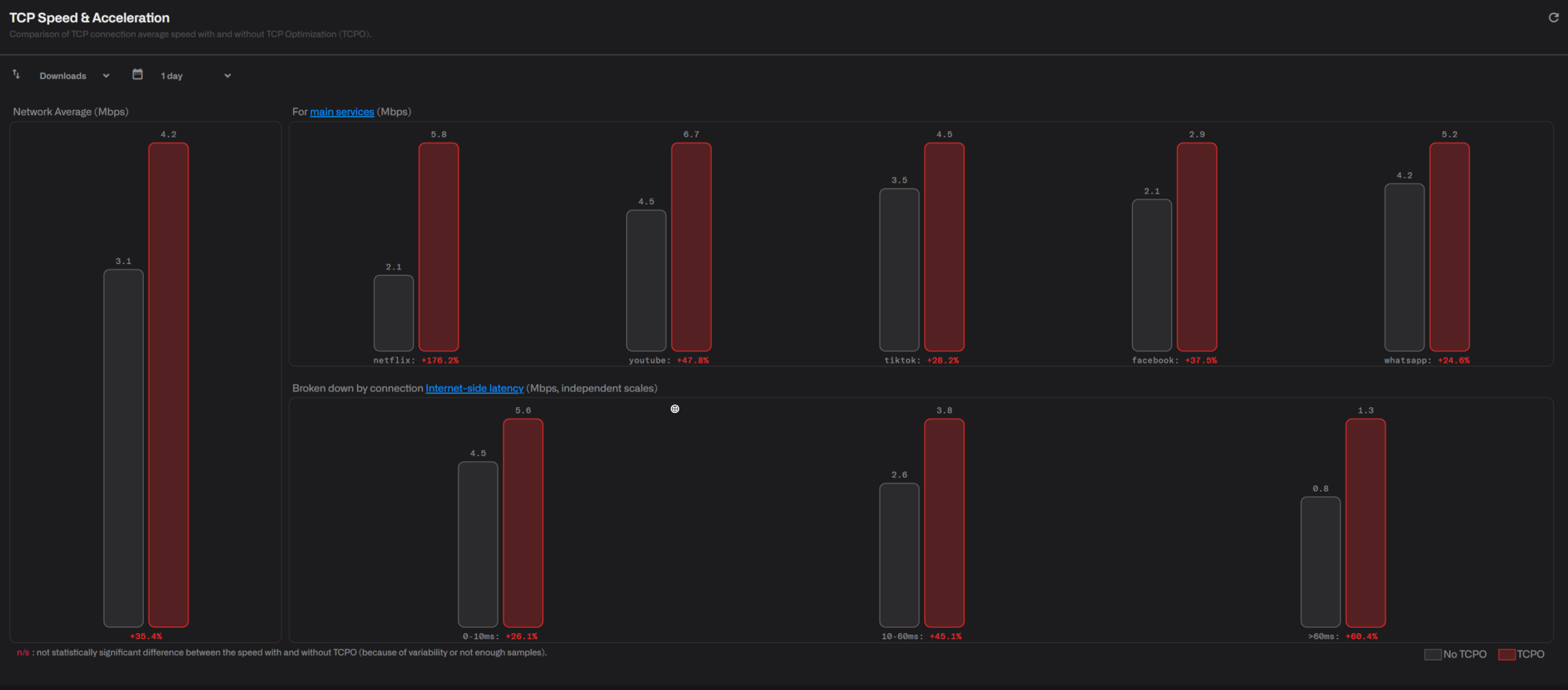
BQN shows the average TCP speeds for optimized and non-optimized traffic, as well as acceleration percentages, so the effect can be evaluated from operational data rather than only from synthetic tests.
TCPO’s contribution to QoE is significant because TCP is still the Internet’s dominant transport protocol. More than ten years after the introduction of UDP-based QUIC (the most popular TCP alternative), TCP still accounts for roughly 70% of overall Internet traffic.
TCPO creates reliable traffic metrics for ACM
ACM continuously monitors users, their speed, latency, and packet losses, detects congestion, and mitigates it to reduce latency and losses. That logic needs trustworthy measurements. TCPO is a natural source for those measurements because it directly tracks the behavior of TCP flows: delivered rate, acknowledgment timing, per-flow speed and retransmission behavior. In other words, TCPO does not merely accelerate the traffic; it instruments the dominant transport protocol in the network.
The result is a stronger congestion-detection loop. If a subscriber’s latency rises while TCP retransmissions increase and delivered speed stops scaling, ACM can treat those signals as evidence that traffic is approaching or exceeding the subscriber’s real bottleneck. Those are exactly the indicators needed to separate low application demand from actual access congestion.
- Speed metrics: TCPO observes whether flows are accelerating, plateauing, or falling below expected rates.
- Latency metrics: BQN can show latency evolution over time.
- Loss metrics: TCP retransmissions indicate packet loss or congestion-related recovery.
TCPO gives AQM native TCP flow control
AQM is designed to prevent bufferbloat when BQN enforces actual or subscribed rate limits. Conventional AQM schemes often rely on packet drops. BQN uses an enhanced variation of FQ-CoDel combined with TCP Optimization to avoid the packet losses associated with other AQM solutions. This combination is significant: TCPO allows BQN to influence TCP sending behavior more directly, so queues can be controlled without allowing loss to become the dominant feedback mechanism.
For TCP traffic, the cleanest place to manage overload is the transport control loop itself. By controlling the effective speed of TCP flows, BQN can keep each flow’s queue short, preserve per-flow fairness, and reduce latency for interactive applications. The AQM queueing layer isolates flows and enforces policy, while TCPO adjusts TCP progression so that the enforced limit is reached with less loss and fewer retransmissions.
Better to have it all: the combined TCPO–AQM–ACM architecture
The three functions are best understood as a layered control system. TCPO optimizes and measures the TCP flows. AQM provides scalable per-flow queueing and policy enforcement. ACM observes subscriber-level symptoms of congestion and adjusts the operating point when the real bottleneck is lower than the configured or unknown plan. Together they turn bandwidth management from a static shaping function into an adaptive QoE-control system.
Deployment concerns are unfounded
Transparent TCP proxying attracts two recurring objections: that it adds complexity to the data path, and that stateful interception is inherently less stable than plain forwarding. Both deserve a direct answer rather than a dismissal, because both describe something real — TCPO does hold per-connection state, and it does participate in the transport loop rather than observing it from the side.
The complexity is genuine, and it is precisely why the capability is provided only by state-of-the-art solutions. Optimizing TCP means processing connections at line rate while tracking window growth, acknowledgment timing, retransmission behavior, and latency for every flow, and then adapting to each connection individually. Most bandwidth-management vendors therefore stop short of it. That difficulty is an argument about who can implement TCP optimization correctly — it is not an argument that the function is unsound.
The answer to the stability objection is implementation maturity rather than a reduced feature set. TCP Optimization runs on a patented TCP implementation, is enabled by default rather than exposed as an expert-only switch, and adapts to each connection automatically, so operators are not asked to hand-tune per-flow parameters to keep it healthy. Non-TCP traffic passes through unaffected. Just as importantly, the results are observable rather than asserted: BQN reports average speeds for optimized and non-optimized traffic side by side, along with acceleration percentages, latency evolution, and retransmission rates, so an operator can confirm the benefit — and the absence of harm — from live traffic in their own network. The deployments described in this document were validated exactly that way.
The benefit of TCPO is the three contributions described above: higher goodput for subscribers, trustworthy transport metrics for ACM, and a native TCP control mechanism that lets AQM enforce limits with less loss. Operators who treat the transport layer as untouchable keep the simplicity but forgo all three.
Case study — BQN impact on real networks
TCPO yields improvements ranging from 10% to 30%. In one ISP deployment, average TCP connection speeds increased from 3.1 Mbit/s to 4.2 Mbit/s, representing a reported improvement of 35.4%. This is operationally meaningful because it reflects better TCP goodput across real subscriber traffic, not only isolated speed tests.
Another example is DigitalC in Ohio and Michigan, USA, where the average speed increased from 5.3 Mbit/s to 5.9 Mbit/s, equivalent to an 11.3% improvement.
Conclusion
BQN TCP Optimization is more than an accelerator. It improves the user experience by increasing TCP goodput, but it also supplies the measurement substrate that ACM needs to detect congestion accurately and the transport-aware control mechanism that helps AQM enforce limits with less latency and packet loss. In a BQN deployment, TCPO, AQM, and ACM therefore operate as complementary parts of the same QoE system: TCPO optimizes and measures flows, AQM manages queues and policy, and ACM detects real subscriber bottlenecks and adjusts traffic before latency and retransmissions degrade the experience.